



International Journal of Appreciative Inquiry
Voices from the Field
Download Voices from the Field
 Keith Storace | Australia
Keith Storace is a registered psychologist with the Psychology Board of Australia (PsyBA) and an associate fellow of the Australasian College of Health Service Management (ACHSM). He works in private practice at kikuIMAGINATION®, providing counselling and psychotherapy for individuals, couples, and groups, consulting on leadership and wellbeing, and facilitating workshops. His work includes Appreciative Dialogue (ApDi) therapy, which helps people find meaning as they navigate challenges. Keith has been the editor of the Voices from the Field column in AI Practitioner since 2016

Nick Heap | United Kingdom
Dr Nick Heap was a scientist, then an OD consultant with ICI (Imperial Chemicals Industries), and has been a volunteer for The Samaritans in the UK as well as a counsellor for Relate. He is a self-employed coach, counsellor, facilitator, and trainer, and helps individuals, teams, and organisations in the charity, private and public sectors to develop. Nick has been using Appreciative Inquiry since 2004.
Over the past decade, I have enjoyed curating Voices from the Field in the Nourish to Flourish section of the AI Practitioner, featuring submissions from practitioners worldwide. Each article tells a story of practice, grounded in the realities of local contexts and lived experience. What stands out most to me is not only the variety of approaches practitioners draw on, but also how much of themselves they bring to their work with others.
Appreciative Inquiry invites us to orient towards life, possibility, and movement, even when contexts are complex or strained. That orientation is carried by those who are present to what is unfolding. When a practitioner is settled enough to listen, stay with uncertainty, and respond rather than react, something different happens in the room. People speak more freely, think more carefully, and begin to notice possibilities that were previously inaccessible.
Nourish to Flourish was created as a dedicated space within AI Practitioner to explore this area of practice. It also offers practitioners a chance to reflect on how they support themselves in demanding roles.
This raises a question I often consider: what helps us sustain the inner conditions that make good collaboration possible – presence, steadiness, and openness – especially over time and under pressure? The answers vary and evolve. What matters is the willingness to remain in relationship with the question itself, to understand how we nourish ourselves to help others flourish.
In this spirit, I am pleased to introduce a new addition to Nourish to Flourish which Nick Heap will lead: a column titled “Practices That Deepen Appreciative Inquiry: Tuning the Human Instrument”. Nick writes about a practice that has strengthened his ability to stay present and responsive in his work. His reflection offers a broader invitation to practitioners to consider the tools, disciplines, and approaches they draw on alongside Appreciative Inquiry, and how these support readiness, presence, and care in practice.
Practices That Deepen Appreciative Inquiry: Tuning the Human Instrument
The best work I’ve ever done has been when I’ve been, as Otto Scharmer would say, in a good interior condition. Then I’ve been aware and present, able to adjust to the situation, respond to what’s in the room, and make things up as I go along.
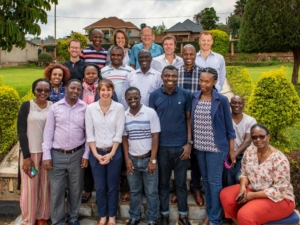
I’m thinking about some team-building work I did in Rwanda in 2009. I had people from six African countries in the group, along with an American, two Dutch participants, and another Brit. I went into it with a few scrappy notes and a simple idea. I sat people in a circle and asked them why they cared about the organisation’s work.
Creating the conditions
That initial setting created the conditions for conversations that led to a growth-full, high-energy event using Appreciative Inquiry and other tools, including “laughter yoga”. It was great fun for everyone involved, so much so that I use a smiling photograph from the end of that workshop as my LinkedIn banner.
The question is, how did I reach that state of being able to be present, of not being stirred up by the complexities of different cultures, but simply responding to people as human beings?
It didn’t happen by accident. For many years, I’ve used a peer counselling process, known by various names, such as re-evaluation counselling or co-counselling. You take turns listening deeply to each other. One person listens with full attention, offering encouragement, warmth, and love, in complete confidentiality. Nothing is repeated to the other person, let alone shared outside the pair.
The person being listened to can explore anything. They can fully express the feelings they have about whatever they’re talking about.
Every time you talk with someone who is truly present and listening, you think and feel better. Perhaps more importantly, you increase your ability to give attention to others in the moment because you’ve dealt with your own stuff. You reach a point where, if someone says or does something that stirs an old memory, you don’t need to deal with it in the moment. You note it mentally and return to it later, knowing you have trusted relationships where you can explore it safely.
Appreciative Inquiry brings life, light, and hope into a world that can appear dark and hopeless
I am looking for stories and ideas for this new column about practices that deepen the way engage with Appreciative Inquiry, stories about how we have, or can, strengthen our appreciative practice by:
- Being in the right state to be present, loving, flexible, challenging, and creative to deliver our best work, and
- Using other practices, disciplines, activities, processes, and ways of thinking to help clients accept and use Appreciative Inquiry.
I don’t think we can help people flourish unless we flourish ourselves.
So, I’m wondering how readers help themselves do their best work. What methods do you use to look after yourself and continue developing?
To contribute your story to my new column, ‘Practices That Deepen Appreciative Inquiry: Tuning the Human Instrument’, get in touch. I’d love to hear from you. Perhaps you’re using other tools, practices, or disciplines alongside Appreciative Inquiry – whether to support your own readiness or to strengthen your work with others.
A short reflection, a story from practice, or even a few paragraphs is enough to get started.
When we work with people, we are human instruments, and all we have is all of us. How do you make sure your instrument is in tune? We love hearing how people have enriched their practice. What else might be possible?