



International Journal of Appreciative Inquiry
A Practitioner’s Journey
Download Voices from the Field
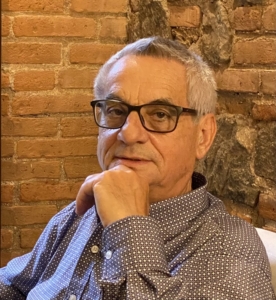 Federico Varona | USA
Federico Varona, born in Spain, has lived and taught in Central America and the USA for 35 years. He is a professor emeritus at San José State University, California. He has taught the Appreciative Research course at San José State University for over ten years. Now he writes about, publishes and delivers international webinars on the Appreciative Paradigm.
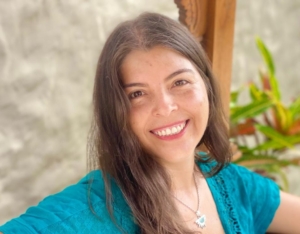 Karen Pérez Molina | RIPAPA
Karen Pérez Molina holds a master’s degree in education and is a PCC‑level coach (ICF), with 21 years of experience in public policy. She teaches at the undergraduate and graduate levels, and is the creator of Mujer Apreciativa (Appreciative Woman). Her work weaves together positive psychology, appreciative inquiry, neuroscience, and ancestral wisdom..
RIPAPA, the Iberoamerican Network of Academics and Practitioners of the Appreciative Paradigm, is a vibrant, multilingual community committed to expanding the Appreciative Paradigm and advancing the practice of Appreciative Inquiry methodology worldwide. Publishing member-generated articles in AI Practitioner, translated from Spanish, opens a global window into our ideas, innovations, and lived experiences. Through writing, we affirm our identity, share our learning, and contribute to the appreciative future we are co creating.
We open this series with Karen Pérez Molina, whose writing invites us into a deeply lived encounter between ancestral wisdom and the Appreciative Paradigm. Writing from within the Iberoamerican context, Karen brings a voice shaped by lineage, land, and lived practice, returning appreciation to its roots in memory, ritual, and relationship. By beginning the series here, we are invited to slow down, listen across generations, and sense how appreciative practice can be lived as a way of being, carried through lineage, reciprocity, and service.”
Appreciative Ancestrality: An Initiatory Path Between Karpay and the Soul’s Questions
What happens when ancestral wisdom meets a contemporary philosophy that honors what gives life? This question opens an initiatory path that weaves together the Andean cosmovision and the Appreciative Paradigm – lived not only as a conceptual framework, but as an experience embodied in the body, the heart, and the soul.
I write these words as an offering during Inti Raymi, the Festival of the Sun that marks a time of spiritual renewal, to share the testimony of a ten day initiatory retreat through the sacred lands of Peru, where I received the three Karpay of the Q’ero lineage. This journey awakened ancestral memories and revealed how the heart of the Appreciative Paradigm also lives within the Andean worldview. The Karpay are rites of transmission of energy and wisdom that activate the spiritual seed, Inca Muju, and open the path of service. The Q’ero lineage, a Quechua nation considered a living guardian of Inca knowledge, has preserved its ancestral wisdom for centuries in the high Andes until receiving the call to share it with the world.
The initiation began with an offering in the heart temple of Pachamama, near Cusco. I understood then that no spiritual path can be walked without profound respect for nature. The gesture of offering – giving, receiving, and giving thanks— – became the central axis of the process, lived as ayni, the principle of reciprocity that sustains life.
The rite unfolded as a language of the soul, awakening essential questions: What meaning do rituals hold in our daily lives? How does the ordinary become sacred? What memories are waiting to be remembered? The A rainbow accompanied this journey as a symbol of the portal that unites the three Andean worlds: Hanan Pacha, Kay Pacha, and Uku Pacha. For the Q’ero elders, it was a sign of blessing and permission to continue.
The first Karpay took place at Lake Titicaca, considered the second chakra of the world. There, in icy waters more than four thousand meters above sea level, I experienced a profound cleansing. My body trembled, my breath quickened, and my heart beat like a drum of life. The energetic transmission occurred in the temple of Pachamama on Amantaní Island. In that sacred space, I received a vision that now guides my purpose: I saw my soul descend into Uku Pacha, nourish itself in the darkness, transform into a firefly, then into a yellow flower, and finally into a bee returning to its hive. I understood that my purpose is not only to accompany, but to serve from a light that blossoms in community.
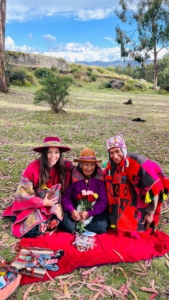
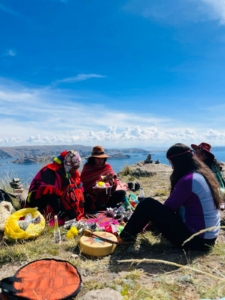
The second Karpay took place at Apu Ausangate, the tutelary mountain of the Q’ero people. Amid strong winds and eternal snows, I experienced a silent dialogue with this ancestral energy. There I understood the gentle strength of presence: life sustains us when we trust and surrender to the greater flow that holds us.
The third Karpay was carried out near Apu Pachatusán, guardian of balance. Through a healing with kuyas – living stones collected from sacred places – I received the transmission of kawsay, vital energy, and yachay, wisdom. The final consecration came, blessed by María Apaza, the last living Alto Misayoq. Her luminous presence sealed the process and confirmed my commitment to service.
This initiatory journey awakened dormant ancestral memories and re signified the Appreciative Paradigm through an embodied experience. I understood that the five phases of Appreciative Inquiry can be lived as a rite of the soul: defining the inner call, discovering the ancestral roots, dreaming from the soul, designing with ritual intention, and delivering with collective purpose.
From this experience, I name appreciative ancestrality as this deep process of remembering what is essential. To remember, in its etymological sense, is to pass again through the heart: to recognize, honor, and collaborate with the universal life force, latent across generations, that awakens within us. It is not only an individual memory; it is, but a collective and intergenerational remembering that emerges from living lineages and Indigenous peoples.
Appreciative ancestrality integrates the Appreciative Paradigm with the Andean cosmovision, understanding that everything we seek already lives within us and simply awaits being remembered. To appreciate is a profound ancestral act. I resonate with Miriam Subirana in understanding appreciation as an act of deep consciousness, and with Federico Varona in recognizing appreciative language as an ethical action that gives voice to knowledge historically silenced.
Today I integrate these learnings into my life and into my gatherings with women, through rituals, drum led visualizations, and practices that connect with the three Andean worlds. Offering is a collective act that generates life. From this awareness arises the question that continues to echo: What offering do we become for the world when we honor what gives us life?
REFERENCES AND FURTHER READING
Jenkins, J. E. (2008) Iniciación: La sabiduría viva de los Andes. Barcelona: Editorial Obelisco.
Subirana, M. (2024) Indagación Apreciativa: Un enfoque innovador para la transformación personal y de las organizaciones (7th ed.). Barcelona: Editorial Kairós.
Varona, F. (2025) Appreciative Paradigm. From Methodology to Paradigm: A New Paradigm for Social Change and Social Sciences. Amazon: Paperback and Kindle.