



International Journal of Appreciative Inquiry
Organizational Transformation through Appreciative Inquiry: Experiences and Reflections on Drenching Processes
Sankarasubramanyan Ramamoorthy and Wasundhara Joshi Routledge, 2026
ISBN 9370036792
ISBN-13 (Kindle) 978-9370036796
Download Appreciative Resources
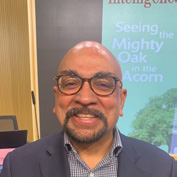 Review by Tojo Thatchenkery
Tojo Thatchenkery, PhD is professor and director of the Organization Development and Knowledge Management program at the Schar School of Policy & Government, George Mason University, Arlington, Virginia, USA.
If you are already familiar with Appreciative Inquiry, the first part of this book’s title may sound familiar. Many books – including my own – have explored Appreciative Inquiry as an approach to organizational change, alongside hundreds of scholarly articles. But it is the second part of the title that immediately captures one’s curiosity: What is “Drenching”? And what could it possibly have to do with organization development?
It was with that question in mind that I began reading Organizational Transformation through Appreciative Inquiry: Experiences and Reflections on Drenching Processes, by Sankarasubramanyan Ramamoorthy and Wasundhara Joshi. For the sake of transparency, I have known both authors and their work for many years, and they have cited some of my own work in this book.
Let’s get drenched!
Here is the elevator pitch I would offer: most books on Appreciative Inquiry emphasize its pragmatic value – the methods and tools that help organizations shift their attention from problems to possibilities. The underlying assumption is that by focusing on what works rather than what is broken, we become better equipped to address challenges. Ramamoorthy and Joshi certainly acknowledge this practical dimension, but they invite us to go much further. They encourage us to immerse ourselves in the process, embrace the journey, remain curious, and allow ourselves to dwell in the emerging possibilities rather than rushing toward conclusions.
Of course, this is an oversimplification. Let me explain.
As the classic work The Social Construction of Reality by Berger and Luckmann (1966) reminds us, language is the primary medium through which we experience and make sense of the world. (If you prefer a lighter – and surprisingly insightful – illustration of this idea, I recommend watching The Gods Must Be Crazy, directed by Jamie Uys, 1984. The film humorously demonstrates how meaning depends on the stories we construct around our experiences.)
An invitation into discovery
Acclaimed German philosopher Martin Heidegger famously observed that “language is the house of Being”. Language is not merely a tool for describing organizations; it shapes how we experience them. We inhabit the worlds that language makes possible. (If you want to read a few sleep-inducingly dense articles about this, I have included three of my own in the references!). Heidegger even argued that poetry represents language in its most authentic form because it opens new possibilities for understanding, whereas everyday language often becomes routine and mechanical. Drenching and Appreciative Inquiry operate in much the same spirit. Through carefully crafted questions, it invites us into discovery, imagination, and the creation of new organizational realities.
This is where the authors’ concept of Drenching becomes especially compelling.
Ramamoorthy and Joshi begin with a solid theoretical foundation for Appreciative Inquiry before introducing a variety of practical models, tools, and applications. Readers will find clear frameworks, useful toolkits, and numerous examples illustrating Appreciative Inquiry in practice. I especially appreciated the global perspective reflected in the case studies. Rather than relying primarily on examples from the western hemisphere, the authors intentionally broaden their lens to include experiences from other parts of the world. Their writing is refreshingly accessible, avoiding unnecessary jargon, making the book suitable for both newcomers and experienced practitioners working in business, government, or nonprofit organizations.
The book’s real contribution, and the “hook” for me, however, lies in its development of the concept of Drenching. The authors write:
Drenching is to soak in the dream. Drenching is standing in the rain and allowing raindrops to seep into each pore of our skin… To drench is to stay in the energy of the dream … In a world where clarity is important, Drenching asks that we remain in a hazy state. (pp. 32–33)
As I read this passage, I found myself thinking of the unforgettable closing scenes of Mira Nair’s Monsoon Wedding (2001), where the characters dance and celebrate joyfully in a torrential rainstorm, seemingly unconcerned about preserving their elegant wedding clothes. It is a beautiful metaphor for surrendering fully to an experience rather than merely observing it or avoiding it all together.
Mindfulness, Appreciative Inquriy and Drenching
My thoughts soon shifted from cinema to theory, particularly to mindfulness. In an article that Ellen Byrne and I published in Harvard Business Review (2018), we argued that mindfulness can significantly enhance creativity within teams. I see a strong conceptual connection between mindfulness, Appreciative Inquiry, and Drenching.
Mindfulness encourages us to experience the present moment without judgment – to observe what is before us without immediately labeling it as good or bad. Jon Kabat-Zinn (1994) so memorably expressed this sentiment in the title of his classic book, Wherever You Go, There You Are. Drenching embodies that same spirit: it invites participants to remain fully present with their experiences, resisting the temptation to move too quickly toward analysis or action.
Traditional Appreciative Inquiry begins with interviews that uncover peak experiences and identify core values. Drenching deepens this process. Rather than simply collecting positive stories, it encourages participants to linger within them, to bring increased awareness of them – to relive them, absorb them, and experience their emotional richness to the fullest form. By cultivating this heightened awareness, I believe, Drenching adds a dimension of mindfulness to Appreciative Inquiry that has the potential to make organization development interventions both richer and more transformative.
I thoroughly enjoyed reading Organizational Transformation through Appreciative Inquiry: Experiences and Reflections on Drenching Processes. Having read dozens of books on Appreciative Inquiry over the years, I found this one refreshingly different. By introducing the concept of Drenching, Ramamoorthy and Joshi remind us that transformative change is not only about asking better questions, or staying positive; it is also about learning to remain fully present (by Drenching) with the possibilities those questions may uncover.
This is a valuable contribution to the Appreciative Inquiry literature, and one that I believe OD and change management practitioners, scholars, and students alike will find both insightful and inspiring.
REFERENCES
Berger, P. and Luckmann, T. (1966) The Social Construction of Reality. Penguin.
Byrne, E. and Thatchenkery, T., (2018, July 12) How to Use Mindfulness to Increase Your Team’s Creativity. Harvard Business Review.
https://hbr.org/2018/07/how-to-use-mindfulness-to-increase-your-teams-creativity
Heidegger, M. (1982) On The Way To Language, (Trans.) P. Hertz, Harper & Row,
Kabat-Zinn, J. (1994) Wherever You Go, There You Are: Mindfulness meditation in everyday life. Hachette, 1994.
Thatchenkery, T. (2004) Paradox and Organizational Change: The transformative power of hermeneutic appreciation. Advances in Appreciative Inquiry, 1, 77–102. DOI: https://doi.org/10.1016/s1475-9152(04)01004-x
Thatchenkery, T. (2002) Mining for Meaning: Reading organizations using hermeneutic philosophy. In R. I Westwood and S. A. Linstead (Eds), pp.112–131. The Language of Organization. Sage. DOI: https://doi.org/10.4135/9781446217368.n6
Thatchenkery, T. (1992) Organizations as Texts: Hermeneutics as a model for understanding organizational change. Research in Organization Development and Change, 6, 197–233.