



International Journal of Appreciative Inquiry
A Practitioner’s Journey
Download Voices from the Field
 Federico Varona | USA
Section editor, A Practitioner’s Journey/RIPAPA
Federico Varona, born in Spain, has lived and taught in Central America and the USA for 35 years. He is a professor emeritus at San José State University, California. He has taught the Appreciative Research course at San José State University for over ten years. Now he writes about, publishes, and delivers international webinars on the Appreciative Paradigm.
From an appreciative paradigmatic point of view, Betsy Martínez’s article, below, makes an original and significant contribution: it applies the Appreciative Paradigm to the human experience of moving through adversity and, in doing so, reveals it in an organic, interdependent, and integrative way through its five essential components – ontology, epistemology, praxis, axiology, and language. From this new way of seeing and operating, which has been profoundly transformative for her, Betsy’s article suggests, implicitly, the possibility of exploring beyond the methodological view of Appreciative Inquiry and of understanding the practice of personal and social change from the Appreciative Paradigm, which shows how everything is integrated, organic, and interdependent, and how this understanding radically transforms our way of seeing, interpreting, inhabiting, and accompanying processes of personal and social change.
 Betsy Martínez Montero
Conscious productivity strategist and business coach. Specialist in Positive Psychology and qualitative researcher in human and organizational wellbeing. TEDx Speaker. Betsy is from Costa Rica and now lives in Mexico.
Life as Mystery: The Appreciative Turn When Facing the Trials We Are Called to Cross Through
There are days when life turns upside down and, without warning, places us before a path we did not ask for. The call that changes everything. The diagnosis. The goodbye. The job that comes to an end. And there, with a somewhat crumpled heart, we face doubts, exhaustion, and even fear; we understand that there is no shortcut: all that remains is to cross through.
Crossing through is not leaping over adversity or pretending it does not hurt. It is crossing a threshold: entering and holding steady, step by step, knowing that once we cross it we will not be the same. And it is not crossed by denying the storm, but by saying yes to life in the midst of pain, doubts, and fear. The suffering we did not choose does not disappear by ignoring it; it becomes inhabitable when we find, even there, a purpose. In this sea of words, I share reflections from my own lived experience, and also from what I have learned while accompanying people on their journeys: you do not need to feel brave when you are afraid, nor strong when you are exhausted. I discovered that crossing through is better done with an appreciative turn.
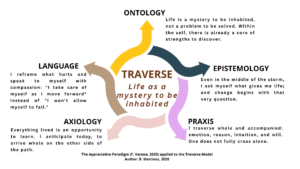
From the Appreciative Paradigm (Varona, 2025), beyond a new paradigm for change, I discover a new way of seeing, inquiring, transforming, valuing, and speaking about ourselves and the world: different ways of being in life that are also different ways of crossing through it.
Seeing differently
Appreciative ontology offers us a perspective that changes everything: life is a mystery to be inhabited, not a problem to be solved. When you stop demanding a solution from yourself, you can finally breathe within what you do not understand. And there is more: in every person, while crossing through their worst storm, there is a core of strengths waiting to emerge. The blows do not destroy that core; often, they are what is needed to reveal its light.
Inquiring into what gives life
Appreciative epistemology invites us to be curious, even in the midst of the storm, about what still enlivens us: in the ordinary, in the extraordinary, and even in the tragic. Instead of questioning only the wound – “what did I do wrong?” – we ask, “what in me has endured, what is still beating, what purpose is this serving for me?” Something extraordinary happens: change does not wait until the end of the road. It begins the moment we start looking with different eyes.
Transforming wholly and together
Appreciative praxis reminds us that no one crosses through completely alone: when your legs falter, someone else walks beside you. We cross through as a whole person: with the emotion that weeps, the reason that brings order, the intuition that sometimes knows before you do, and the will that takes one more step. Not with relentless strength, but with complete presence. From there, we build small prototypes of the future: a gesture, a loving boundary, an “I will solve it tomorrow”.
Valuing what sustains
Appreciative axiology chooses to appreciate what gives life in any context, because it believes that everything that happens to us is an opportunity to learn. Here lives the anticipatory principle: we move toward the image we hold of the future. Imagining who you want to be on the other side is not denying the present; it is planting direction in the midst of the fog.
Naming anew
Appreciative language affirms that words create the world we live in and the one we want. That is why it listens to the negative in order to reframe it: “this thing that breaks me also shows me what matters to me”. And it seeks a committed language, moving from the impersonal “one must be strong” to “I will take care of myself as I move forward”. That nuance, so small, can sustain us through entire nights.
Five components that do not come one after another, but rather interweave each time we decide to cross through. And it is worth saying with tenderness: at some point in the journey you will feel that you are in no-man’s-land, where what came before is no longer there and what is new is not yet understood. That unsettled middle is not a sign that something is wrong with you; it is the fertile zone, the seedbed where, beneath the path, what is to come is being formed. And that middle cannot be rushed; the new beginning cannot be forced. It emerges when you are ready inside, at your own pace and not by anyone else’s clock.
I think of someone who lost their job at fifty and, instead of repeating “I am no longer useful,” dared to ask what they were made of; or I think of someone who lost a loved one and, instead of trying to “get over it,” dared to cross through grief without sweeteners or shortcuts. The storm did not change; the way of crossing through it did.
On this journey, we are not heroes without scars. We become more compassionate people, more attentive to what gives life, capable of naming the good even while life remains a mystery we do not control. We discover that strength was not the absence of fear, but companionship for fear. Today you do not have to be brave or relentless, nor cross in a single leap. Just take one step, and then another, noticing what still blooms within you; sustaining yourself in a purpose that matters to you. That, too, is crossing through. And on the other side, I promise you, there is a version of you waiting to be inhabited.
Varona, F. (2025) Appreciative Paradigm. From Methodology to Paradigm. A New Paradigm for Personal and Social Change and Social Sciences. Available from Amazon in print and Kindle formats, in Spanish, English, and Portuguese.
Desde una lectura paradigmática apreciativa, el artículo de Betsy Martínez realiza una contribución original y significativa: aplica el Paradigma Apreciativo a la experiencia humana de atravesar la adversidad, y al hacerlo lo revela de manera orgánica, interdependiente e integradora a través de sus cinco componentes esenciales — ontología, epistemología, praxis, axiología y lenguaje. Desde esta nueva forma de ver y operar, que ha sido profundamente transformadora para ella, el artículo de Betsy parece invitarnos, de manera implícita, a explorar más allá de la mirada metodológica de la indagación apreciativa y a comprender la práctica del cambio personal y social desde el paradigma apreciativo, que muestra cómo todo está integrado, orgánico e interdependiente, y cómo esa comprensión transforma radicalmente nuestra manera de ver, interpretar, habitar y acompañar los procesos de cambio personal y social.
Betsy Martínez Montero
Conscious productivity strategist and business coach. Specialist in Positive Psychology and qualitative researcher in human and organizational wellbeing. TEDx Speaker. Betsy is from Costa Rica and now lives in Mexico.
La vida como misterio: El giro apreciativo ante los embates que nos toca cruzar
Hay días en que la vida da un vuelco y, sin avisar, nos pone frente a un camino que no pedimos. La llamada que lo cambia todo. El diagnóstico. El adiós. El trabajo que termina. Y ahí, con el corazón algo arrugado, nos enfrentamos a dudas, cansancio y hasta miedo; comprendemos que no hay atajo: solo queda atravesar.
Atravesar no es saltar por encima de la adversidad ni fingir que no duele. Es cruzar un umbral: entrar y sostenerse, paso a paso, sabiendo que al cruzarlo… no seremos los mismos. Y no se cruza negando la tormenta, sino diciéndole sí a la vida en medio de ella; con dolor, dudas y miedo. El sufrimiento que no elegimos no desaparece al ignorarlo; se vuelve habitable cuando encontramos, aun ahí, un para qué.
En este mar de palabras, comparto reflexiones desde mi propia piel; pero también, es algo que aprendí acompañando personas en sus travesías: no necesitas ser valiente cuando tienes miedo, ni fuerte cuando estás agotado. Descubrí que se atraviesa mejor con un giro apreciativo.
Desde el Paradigma Apreciativo (Varona, 2025), más allá del nuevo paradigma para el cambio, descubro una forma nueva de ver, indagar, transformar, valorar y hablar de nosotros mismos y del mundo. Distintas maneras de estar en la vida que son también distintas maneras de atravesarla.
Ver distinto
La ontología apreciativa nos ofrece una mirada que lo cambia todo: la vida es un misterio que se habita, no un problema que hay que resolver. Cuando dejas de exigirte una solución, por fin respiras dentro de lo que no entiendes. Y hay algo más: en cada persona, atravesando su peor tormenta, existe un núcleo de fortalezas esperando emerger. Los embates no la destruyen; muchas veces son lo necesario para mostrar su luz.
Investigar lo que da vida
La epistemología apreciativa nos invita a ser curiosos, incluso en plena tormenta, lo que todavía nos anima: en lo ordinario, en lo extraordinario y hasta en lo trágico. En vez de interrogar solo la herida, “qué hice mal”, preguntamos “qué de mí ha resistido, qué sigue latiendo, para qué me está sirviendo esto”. Y ocurre algo extraordinario, el cambio no espera al final del camino. Comienza en el instante en que empezamos a mirar con otros ojos.
Transformar entero y acompañado
La praxis apreciativa nos recuerda que nadie atraviesa del todo en soledad: cuando tus piernas dudan, alguien más camina al lado. Se atraviesa completo, entero como persona: con la emoción que llora, la razón que ordena, la intuición que a veces sabe antes que tú, y la voluntad que da un paso más. No con fuerza implacable, sino con presencia completa. Desde ahí construimos pequeños prototipos del futuro: un gesto, un límite amoroso, un “mañana lo resolveré”.
Valorar lo que sostiene
La axiología apreciativa elige apreciar lo que da vida en cualquier contexto, porque cree que todo lo que nos pasa es oportunidad para aprender. Aquí vive el principio anticipatorio: nos movemos hacia la imagen que sostenemos del futuro. Imaginar quién quieres ser del otro lado no es negar el presente; es sembrar dirección en medio de la niebla.
Nombrar de nuevo
El lenguaje apreciativo afirma que las palabras crean el mundo en que vivimos y el que queremos. Por eso escucha lo negativo para reformularlo: “esto que me rompe también me muestra lo que me importa”. Y busca un lenguaje comprometido, del impersonal “hay que ser fuerte” al “yo voy a cuidarme mientras avanzo”. Ese matiz, tan pequeño, sostiene noches enteras.
Cinco componentes que no van uno tras otro, sino que se entretejen cada vez que decidimos cruzar. Y conviene decirlo con ternura: en algún punto de la travesía te sentirás en tierra de nadie, donde lo anterior ya no está y lo nuevo todavía no se entiende. Esa mitad revuelta no es señal de que algo ande mal en ti; es la zona fértil, el semillero donde bajo el camino, se gesta lo que viene. Y a esa mitad no se le puede meter prisa, el nuevo comienzo no se fuerza; brota cuando por dentro estás listo, a tu ritmo y no al del reloj de nadie.
Pienso en quien perdió su empleo a los cincuenta y, en vez de repetir “ya no sirvo”, se atrevió a preguntar de qué estaba hecho; o pienso en alguien que perdió a un ser querido y, en vez de intentar “superarlo”, se atrevió a atravesar el duelo sin edulcorante ni atajos. No cambió la tormenta, cambió la forma de atravesarla.
En este viaje, no somos héroes sin cicatrices. Nos volvemos personas más compasivas, más atentas a lo que da vida, capaces de nombrar lo bueno, aunque la vida siga siendo un misterio que no controlamos. Descubrimos que la fortaleza no era ausencia de miedo, sino compañía para el miedo. Hoy no tienes que ser valiente ni implacable, ni cruzar de un salto. Solo da un paso, y luego otro, mirando lo que aún florece en ti; sosteniéndote en un para qué que te importe. Eso, también, es atravesar. Y del otro lado, te lo prometo, hay una versión tuya esperando ser habitada.
Varona, F. (2025) Paradigma apreciativo: De la metodología al paradigma. Un nuevo paradigma para el cambio personal y social y las ciencias sociales. Amazon. Disponible en formato impreso y Kindle, en español, inglés y portugués.